

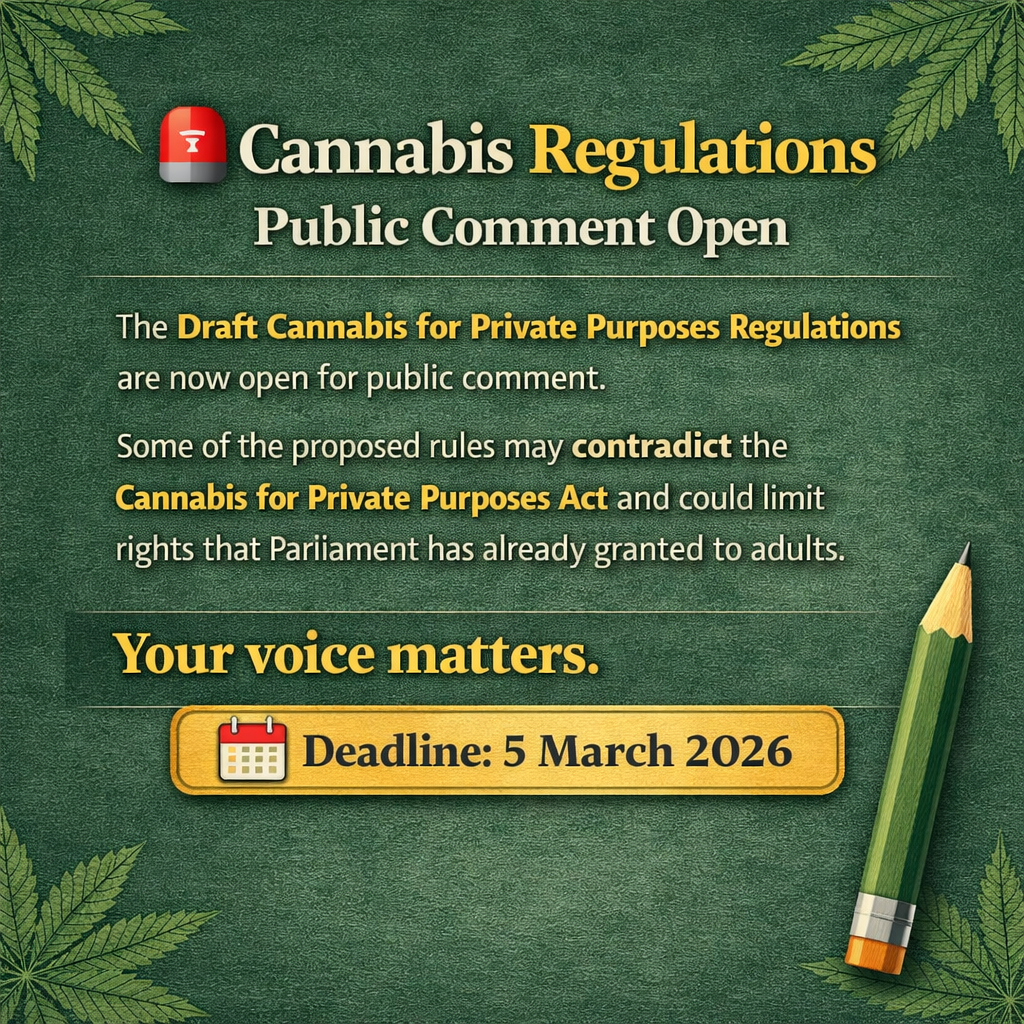
Dave Your Say on the Cannabis Regulations
The Draft Cannabis for Private Purposes Regulations are currently open for public comment in South Africa.
These regulations are intended to implement the Cannabis for Private Purposes Act, which was passed following the Constitutional Court ruling recognizing that adult cannabis use and cultivation in private fall within the constitutional right to privacy.
However, many stakeholders have raised concerns that some of the draft regulations may contradict the Act or go beyond what Parliament approved.
Public participation is an important part of the legislative process.
To help citizens participate, we’ve created a simple public comment template you can use when submitting your response.
Key Issues in the Draft Regulations
Several aspects of the proposed regulations raise legal and practical concerns:
• Plant limits and the right to cultivate
• Possession limits vs lawful harvest
• Transport restrictions between private places
• Household vs individual cultivation rights
• Fresh vs dried cannabis weight after harvest
• Potential constitutional privacy concerns
These issues could affect how the law is implemented and enforced in practice.
How to Submit Your Comment
Submitting a comment is simple.
Step 1
Copy the submission template below.
Step 2
Add your name and city.
Step 3
Send your submission to the department before the Deadline 05 March 2026. Email MMokulubete@justice.gov.za
You are welcome to edit the template and include your own views.
Public Comment Template
Dear Sir/Madam,
I respectfully submit the following comments on the Draft Cannabis for Private Purposes Regulations recently published for public comment. These comments are provided in the interest of ensuring that the final regulations remain consistent with the Cannabis for Private Purposes Act and the constitutional principles established by the Constitutional Court.
The Cannabis for Private Purposes Act was adopted to give effect to the Constitutional Court judgment in Prince v Minister of Justice and Constitutional Development, which recognized that the use, possession and cultivation of cannabis by adults in private fall within the constitutional right to privacy. The Act therefore seeks to regulate these activities in a manner that respects this constitutional principle while providing legal clarity.
After reviewing the Draft Regulations, I would like to highlight several concerns:
1. Plant Limits and the Right to Cultivate
The Draft Regulations introduce strict numerical limits on the number of cannabis plants that adults may cultivate. While the Act allows the Minister to prescribe limits, these limits should remain reasonable and consistent with the purpose of the Act.
Cannabis plants vary significantly in terms of size, yield and sex. Many plants may produce little or no usable cannabis, and cultivation often requires multiple plants to account for plant sex, plant health, harvest cycles and potential crop loss. Extremely restrictive plant limits may therefore undermine the right of adults to cultivate cannabis for personal use, as recognised in the Act.
2. Possession Limits vs Lawful Harvest
The Draft Regulations propose limits on the amount of cannabis that an adult may possess. However, these limits appear inconsistent with the realities of home cultivation.
A single lawful harvest from a small home grow could easily exceed the proposed possession limits. This creates a situation where an adult could become criminalised immediately after harvesting plants that they were legally permitted to cultivate. Such an outcome appears inconsistent with the intention of the Act and risks criminalising conduct that Parliament intended to protect.
3. Transport Restrictions and Practical Exercise of Rights
The Draft Regulations also introduce restrictions on the amount of cannabis that an adult may transport.
However, transportation is often necessary for the practical exercise of rights granted by the Act. Adults may need to transport cannabis between private residences, move cannabis after harvest, or share cannabis privately with another consenting adult without remuneration.
4. Personal Consumption vs Arbitrary Quantities
Personal consumption varies significantly between individuals. Cannabis cultivation also produces harvest cycles, meaning individuals may possess larger quantities following a lawful harvest. Strict numerical possession limits that do not account for this reality may inadvertently criminalise lawful private cultivation.
5. Individual vs Household Rights
The Act recognises that cannabis may be cultivated within a private dwelling where multiple adults may reside. Regulations that do not clearly accommodate household cultivation may create uncertainty and unintentionally restrict rights granted by the Act.
6. Fresh vs Dried Cannabis Weight
Cannabis plants are harvested as fresh plant material with high water content. During the drying process cannabis can lose 70–80% of its weight. If possession limits are defined only in terms of dried cannabis, individuals could temporarily exceed possession limits during lawful post-harvest processing.
7. Ultra Vires Concerns
Regulations must remain within the scope of the enabling Act passed by Parliament. Where regulations introduce restrictions that effectively limit rights granted by the Act, they may be considered ultra vires and therefore unlawful.
8. Constitutional Privacy and Proportionality
The Constitutional Court confirmed that criminalising adult cannabis use and cultivation in private infringes the right to privacy. Regulations that impose excessive restrictions may undermine this principle and could require intrusive enforcement in private homes.
For these reasons, it is recommended that the Department reconsider aspects of the Draft Regulations to ensure that they:
• Align with the Cannabis for Private Purposes Act
• Respect the constitutional right to privacy
• Avoid restrictions that undermine rights granted by Parliament
• Provide practical and realistic limits
Regulations that are practical, constitutionally compliant and consistent with the Act will strengthen public confidence in the regulatory framework.
Thank you for the opportunity to provide public comment.
Kind regards
[Your Name]
[City / Province]
Why Public Participation Matters
Public comments help government departments understand how proposed regulations may affect citizens in practice.
Constructive submissions from citizens, activists, growers and legal experts can help ensure that the final regulations are:
• Fair
• Practical
• Constitutionally compliant
• Aligned with the Cannabis for Private Purposes Act
Share This Page
If you support fair cannabis laws in South Africa, please share this page with others so they can participate in the consultation process.
Public participation helps ensure the final regulations reflect the rights recognized by the Constitution and Parliament.